Research paper · public data AI-assisted build
Do bank stocks react to Bank of Canada rate changes?
It is widely believed that higher interest rates are good for bank shareholders. This study tests that on every change in the Bank of Canada’s policy rate over fifteen years and finds no reaction large enough to detect.
The question
Do bank shares rise when the Bank of Canada raises rates and fall when it cuts? And does it depend on how surprised the market was?
The method
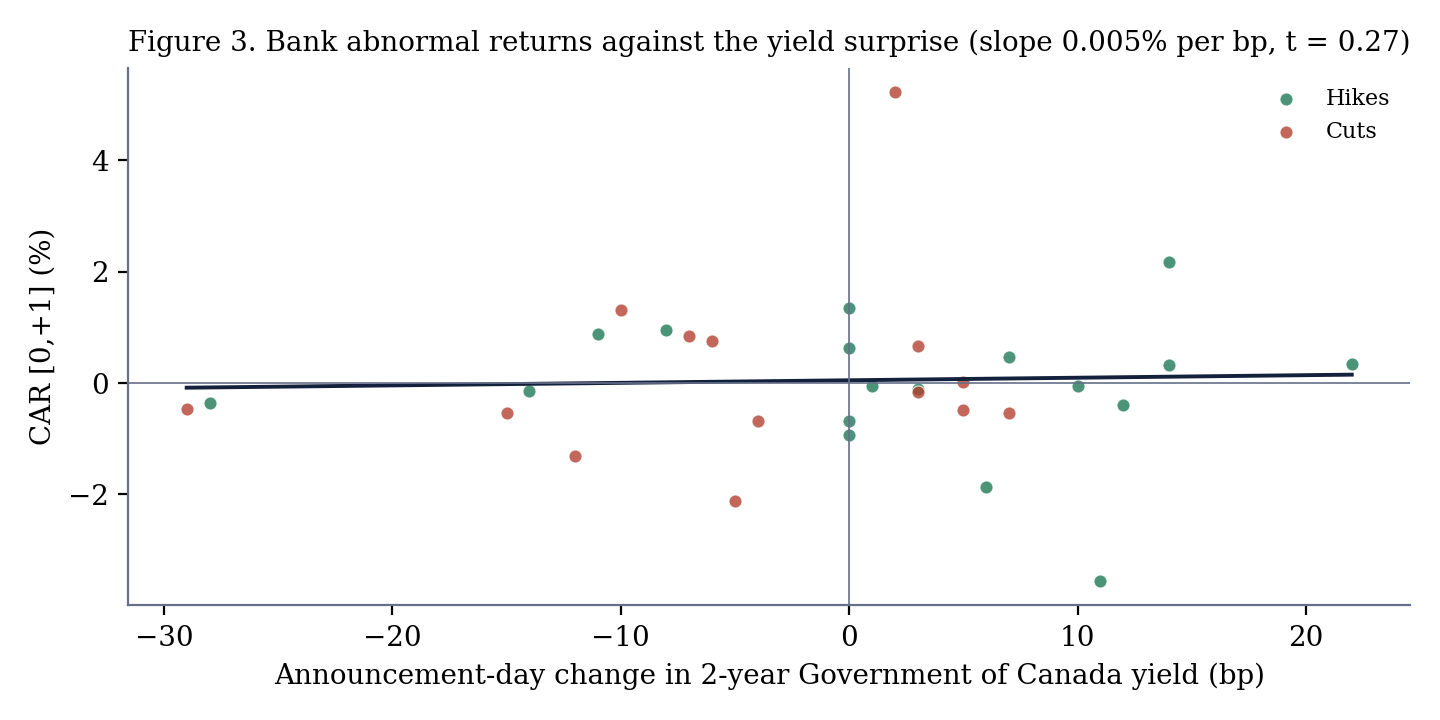
A market model is estimated for each event on the prior 250 trading days. Abnormal returns are tested three ways, then regressed on the same-day move in the two-year Government of Canada yield.
The finding
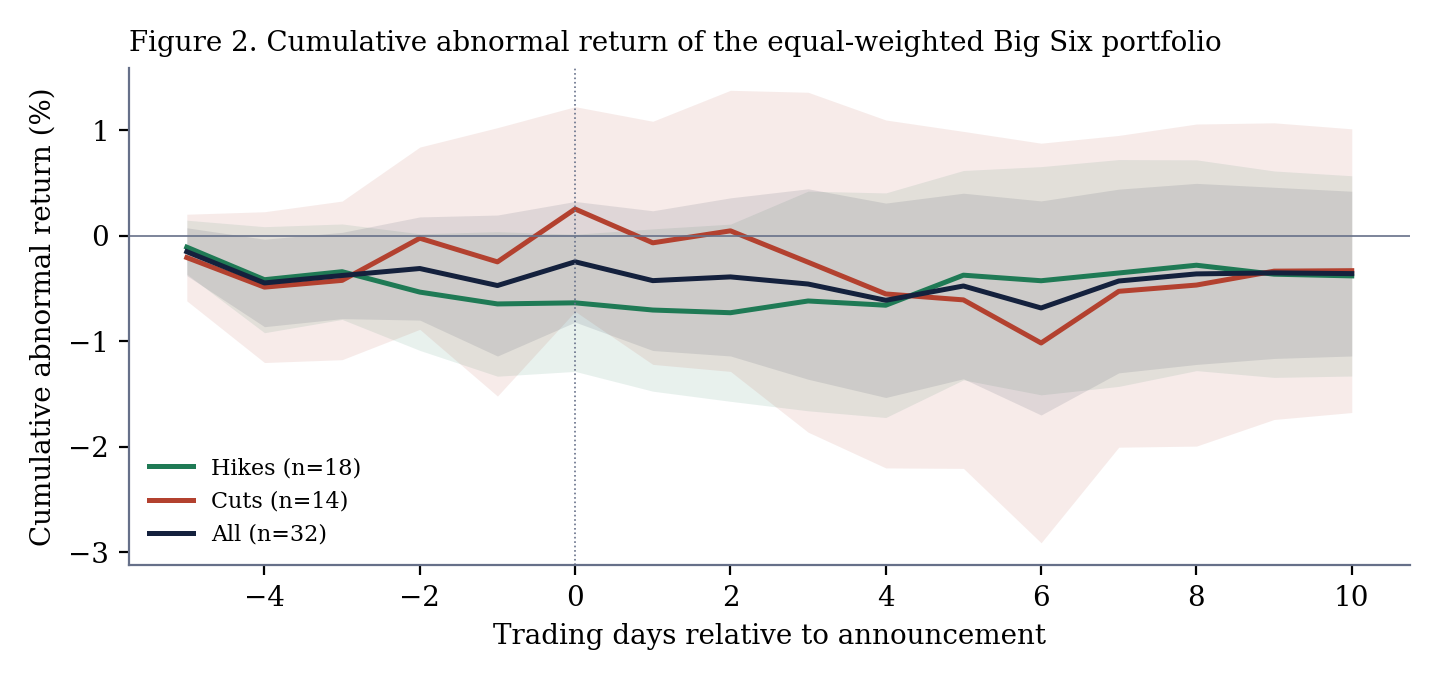
None that this study can detect. The average reaction is 0.05%, and hikes and cuts are indistinguishable. An effect smaller than about 0.6 percentage points would not show up in a sample this size, so the finding is “no large reaction”, not “no reaction”.
What the result does and does not show
It puts a number on a common belief. The slope of bank returns on the yield surprise is 0.0046% per basis point with a t-statistic of 0.27.
The first result was wrong, and the paper says so. The first pass showed announcement days were 16 times more volatile than normal. Removing three dates in March 2020 took that to 0.85. The paper reports both.
It says what it cannot rule out. A power calculation shows the sample could detect an average effect of about 0.6 percentage points. Anything smaller is beyond its reach, and the paper says so.
How it was built
AI did the building. The data pipeline, the statistical analysis, the figures and the paper was produced by Claude, an AI model made by Anthropic, working at my direction. I asked for an empirical study on real public data with a paper, code and data; Claude chose the question and the method, wrote the Python and drafted the paper.
My role was to set the brief, read the result and decide what is published. I can explain what the study asks and what it found. I am still working through the statistical methods and do not present them as my own technique.
Read it, open it, re-run it
Everything needed to check the work is here. The paper is generated by a script from the results file, so no number is typed by hand.
Public data only. No client or employer information is used. Not investment advice; views are my own.
Let’s talk.
Open to permanent roles in client onboarding, wealth operations and finance operations in the Greater Toronto Area. Email is the fastest way to reach me.